
Marrying the WRONG Person & Finding the RIGHT Life | Wendy B.
Listen or watch on your favorite platforms
 YouTube
 Apple Podcasts
 Spotify
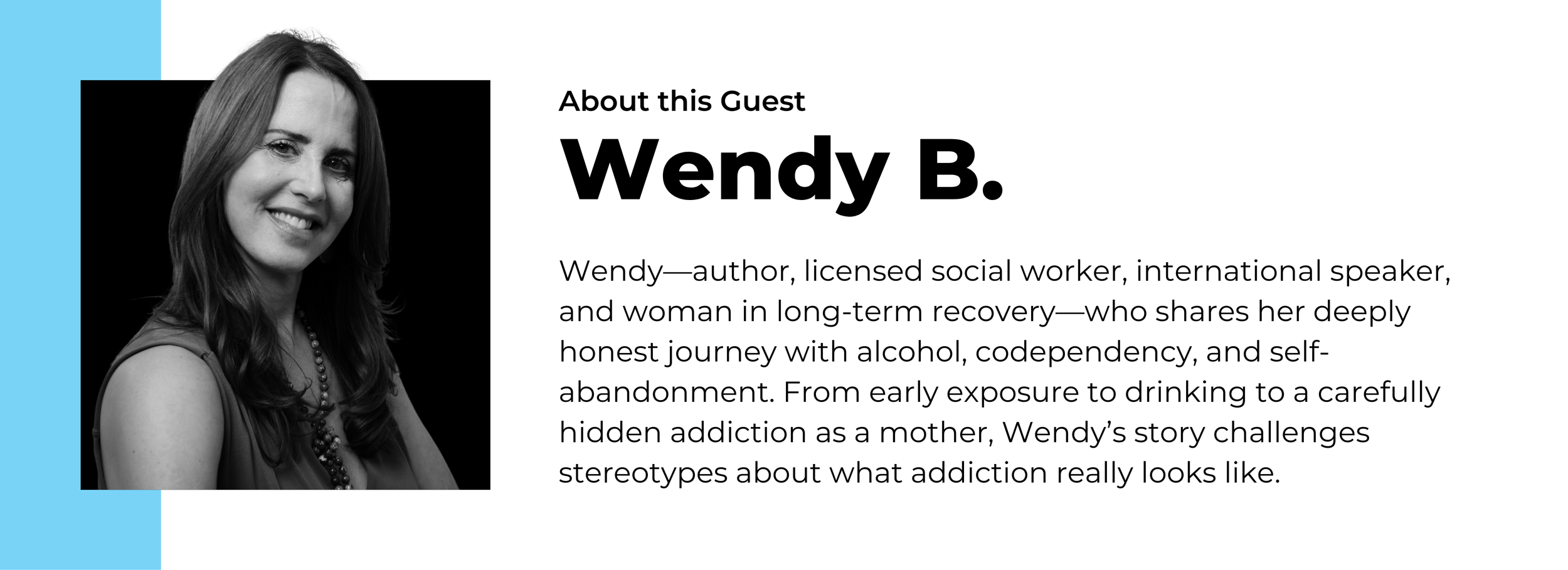
Wendy opens up about growing up in an enmeshed family system, blacking out at a young age, and slowly escalating from “functional” drinking to secret vodka bottles and pills hidden in shoeboxes. Outwardly, she appeared to be doing everything right—raising kids, managing a household—but internally, she was unraveling.
Her turning point came after a public, painful bottom that forced her to finally ask for help. Through recovery, therapy, and deep inner work, Wendy rebuilt her life, returned to graduate school at 40, and learned how to set boundaries, speak her truth, and live by her values. Today, she helps others find healing through multiple recovery pathways.
Growing Up — Love, Enmeshment, and Early Normalization
From the outside, Wendy’s childhood looked full of opportunity, closeness, and love. She was an only child, deeply bonded with her parents, and raised in an environment where family time revolved around shared experiences—Broadway shows, tennis, horseback riding, vacations, and evenings together. Alcohol was present, but not questioned. Her father poured a drink every night after work. Her parents drank together in the evenings. It was normal. It was social. It was family.
At just six years old, Wendy had her first taste of alcohol—dipping her finger into her father’s glass of scotch and licking it. “I remember thinking, this tastes really good,” she later shared. That moment, small as it seemed, planted a seed. Alcohol wasn’t dangerous or forbidden—it was familiar, comforting, and woven into connection.
Wendy describes her upbringing as loving, but also deeply enmeshed. She was her parents’ world, and they were hers. There were few boundaries, and a powerful undercurrent of people-pleasing formed early. Her role was to be good, to make others happy, to say yes—even when she didn’t yet know how to listen to herself. “I didn’t even know I had needs,” she would later reflect.
That lack of separation—combined with early exposure—quietly shaped how Wendy learned to cope, relate, and soothe herself.
First Use — Feeling Seen, Free, and Fearless
By her early teens, alcohol wasn’t just present—it was central. Wendy’s father was a liquor salesman who serviced Manhattan’s most exclusive restaurants and clubs. By age thirteen, Wendy was partying in New York City, drinking openly, dancing on speakers, and earning the nickname “Wild Wendy.”
She describes blacking out, throwing up, and laughing through it all—because that’s what everyone around her did. It felt exhilarating. Alcohol dissolved her self-consciousness and amplified her sense of belonging. “I was having fun,” she said—even when the fun came with consequences.
By high school, substance use escalated. She smoked marijuana before school, struggled with mood swings, and became known as the class clown—brilliant one day, disruptive the next. Adults noticed something was wrong, but no one connected the dots. Alcohol and drugs weren’t framed as warning signs; they were part of the culture.
Inside, Wendy was already using substances to regulate emotions she didn’t yet have language for—anxiety, anger, insecurity, and a constant sense that she needed to perform to be loved.
Active Addiction — Functioning on the Outside, Falling Apart Inside
Wendy excelled academically, graduating college summa cum laude while living a double life. She was drawn to relationships that mirrored her inner chaos, including a boyfriend involved in drug dealing. Later, she married young—at 22—choosing a partner based on surface traits: success, charm, humor. “That’s not a reason to get married,” she later admitted.
Motherhood followed, and from the outside, Wendy looked like the definition of a “high-functioning” adult. She showed up for her children. She managed the household. She kept it together—until 6 p.m.
Every evening, the ritual began. Wine turned into vodka. Vodka was hidden in shoeboxes in the basement. Warm liquor didn’t matter anymore. Pills entered the picture. Alcohol became “liquid courage,” the only way she felt able to express anger, assert herself, or feel relief.
Her personality shifted unpredictably. Sometimes she seemed fine. Other times, she lashed out. Arguments intensified. Resentment grew. The emotional fallout rippled through her marriage and her children’s lives. “I felt powerless,” she said. And drinking became the only escape she knew.
Hitting Bottom — When the Mask Finally Fell
The breaking point came at a wedding. Wendy’s husband asked her beforehand, “Please don’t drink a lot.” The request ignited defiance. She instructed the bartender to keep refilling her glass. She drank until she blacked out.
This time, her children were there. They saw it.
The next morning, her husband—who rarely showed emotion—cried. Her parents came over. And for the first time, the consequences were undeniable. Shame, fear, and clarity collided.
In a moment that Wendy describes as divinely guided, she opened the Yellow Pages and found an AA meeting. The next day, she raised her hand and said the words that changed everything:
“Hi, I’m Wendy, and I’m an alcoholic.”
“A weight lifted off of me,” she said. Not because everything was fixed—but because she finally stopped running.
Getting Help — Learning to Ask, Stay, and Do the Work
Recovery didn’t come from a single action. It came from commitment. Wendy went to meetings. She found a sponsor. She entered therapy. She followed suggestions. She replaced wine with tea. Isolation with community.
“This really wasn’t about not drinking,” she realized. It was about learning how to live.
As she got sober, she began to grow—and the distance between her and her marriage became undeniable. She was healing. Her partner was not. With courage she never had before, Wendy returned to graduate school at 40 and became a licensed clinical social worker.
Recovery also exposed patterns beyond alcohol. People-pleasing. Codependence. Boundarylessness. Through Al-Anon and later ACA (Adult Children of Alcoholics and Dysfunctional Families), Wendy learned how to say no, tolerate discomfort, and choose herself without guilt.
“What other people think of me is none of my business,” became more than a phrase—it became a practice.
Life Today — Purpose, Peace, and Passing It On
Today, Wendy has over 28 years of sobriety. She is an author, therapist, speaker, and creator of the Happiness Recovery System, helping individuals and families heal not just from addiction—but from the emotional patterns that fuel it.
Her life is grounded in balance, boundaries, spirituality, and service. She still does the work. She still shows up. And she lives by the advice she would give her younger self:
“Don’t quit before the miracle. And ask for help.”
Her story stands as proof that recovery isn’t about perfection—it’s about honesty, courage, and choosing yourself one day at a time.
FAQs
What causes someone to develop an alcohol addiction?
Addiction often develops from a combination of early exposure, emotional coping patterns, environment, and unmet needs.Can someone be addicted even if they appear “high-functioning”?
Yes—many people maintain careers and families while struggling internally with addiction.Is recovery possible without rehab?
Yes, recovery can happen through various paths including therapy, support groups, and community-based programs.How does codependence relate to addiction?
Codependence often fuels addiction by prioritizing others’ needs over one’s own emotional health.Is it ever too late to get sober?
No—recovery can begin at any age and still lead to meaningful, fulfilling change.
Related episodes


ABOUT CROSSTALK

CROSSTALK reveals real stories of everyday people and notable figures, sharing their journeys from struggles to life-changing 'aha' moments with all kinds .


I Spent Years Running From Myself Until Recovery Taught Me to Be Seen